Flow Arts Fashion: A Community Guide to Performance Wear, LED Accessories, and Dressing for the Art Form
-
 RaveShax Editors
 - 14 Apr, 2026
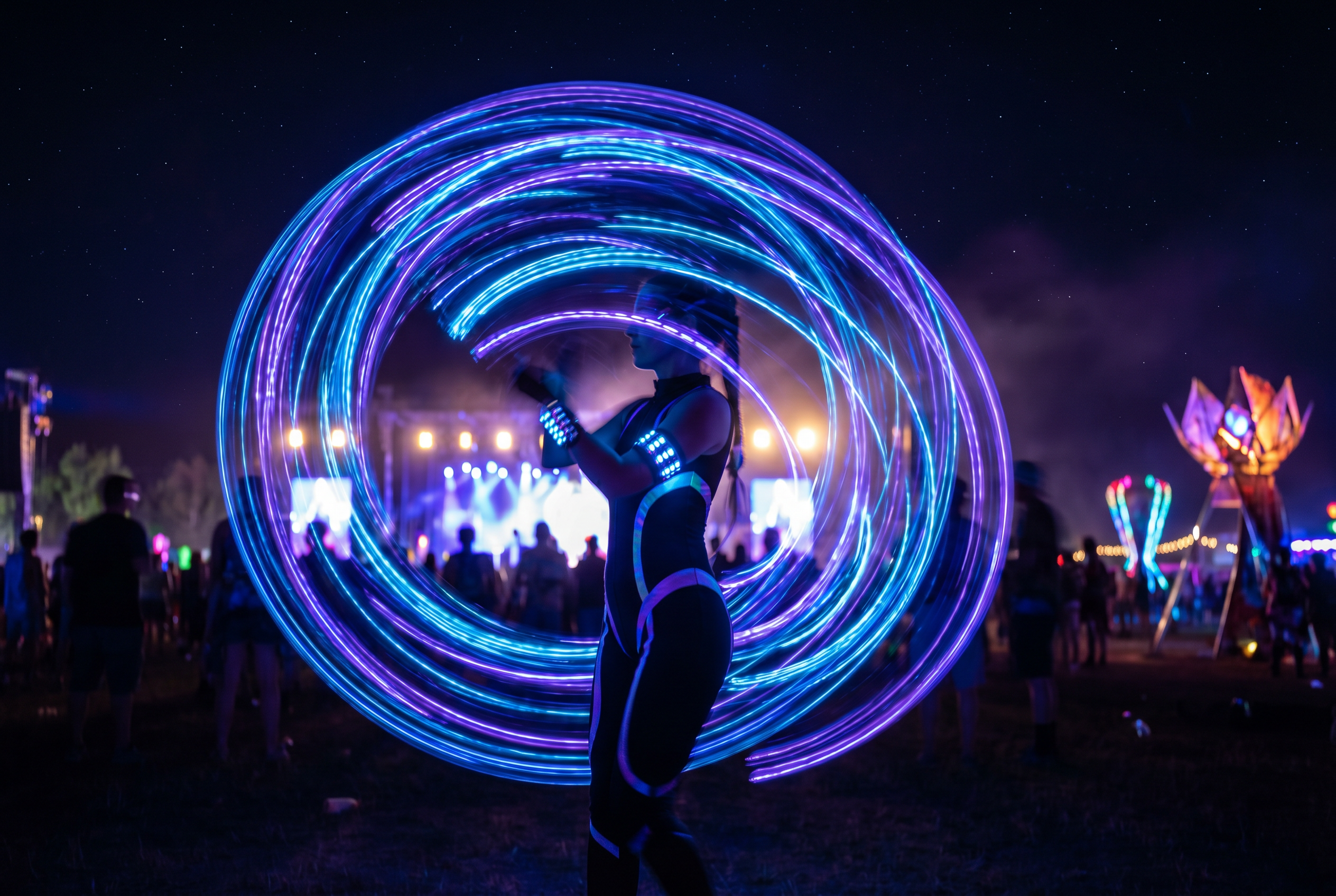
Picture a poi dancer mid-spin at EDC Las Vegas. The LED poi trace arcs of light through the dark — blue, then white, then a wash of violet — and for a moment the crowd stops moving to watch. The dancer’s outfit is not incidental. The holographic fabric catches the stage wash and throws it back. The silhouette is clean enough that the poi trails read clearly. The fit allows a full 360-degree arm extension without restriction. None of that happened by accident.
Flow arts is a discipline — poi, staff, hoop, fans, juggling, contact ball, rope dart, and the dozens of forms that have evolved from them. The practitioners who carry these disciplines are among the most fashion-conscious, community-embedded members of any festival audience. When your outfit is part of the performance, every fabric choice, every LED component, and every silhouette is a design decision. This guide is for the people who understand that.
What Is Flow Arts? (And Why the Fashion Matters)
Flow arts is a family of movement disciplines that sit at the intersection of performance, visual culture, and community. The term encompasses any practice that uses props — poi, staff, hoops, fans, juggling props, contact ball, rope dart — in a movement practice oriented toward flow state: the psychological condition of complete absorption in a challenging, rewarding activity.
The PLUR lineage is direct. Flow arts emerged from rave culture in the 1990s, when glowsticking evolved into poi and the first generation of LED props appeared on festival floors. The community that grew around these practices is among the most tightly knit in rave culture — practitioners recognize each other across festivals, trade techniques, and form communities that persist year-round.
Why does fashion matter in flow arts? Because the outfit is part of the performance. A poi dancer performing at night is creating a visual experience — the trails of light, the silhouette, the way the fabric moves with the body. Every element of the outfit contributes to or detracts from that visual experience. A baggy shirt that catches the poi cord is a safety issue. A fabric that absorbs light instead of reflecting it diminishes the visual impact. A silhouette that obscures the body’s movement makes the technique harder to read.
Flow arts fashion is not decoration. It is equipment.
The Four Disciplines and What Each One Demands from an Outfit
Each flow arts discipline has specific physical requirements that translate directly into outfit requirements. Understanding these requirements is the foundation of dressing for the art form.
Poi: Full Range of Motion, No Cord Interference
Poi — two weighted objects on cords or chains, swung in patterns around the body — requires complete freedom of movement in the shoulders, arms, and torso. The primary outfit concern is cord interference: any loose fabric, dangling accessory, or ill-fitting sleeve can catch a poi cord mid-spin, disrupting the flow and creating a safety risk.
What poi demands: Close-fitting upper body. No loose sleeves, no dangling jewelry, no scarves or flowing fabric near the arms. The lower body can be more relaxed — wide-leg pants and flowing skirts work well for poi because the props operate primarily in the upper body plane.
Ideal poi outfit: Fitted crop top or sports bra + high-waist wide-leg pants or a flowing skirt. The upper body is clean and close-fitting; the lower body adds visual interest and movement.
Staff: Structural Silhouette, Visible Body Lines
Staff — a rigid prop spun around the body in contact moves — requires a different approach. The staff passes close to the body, and the practitioner’s silhouette needs to be readable for the technique to communicate visually. Baggy clothing obscures the body lines that make staff technique legible.
What staff demands: A silhouette that reveals the body’s position at all times. Fitted clothing throughout — not necessarily tight, but structured enough that the body’s geometry is visible. Fabric that moves cleanly without billowing.
Ideal staff outfit: Fitted bodysuit or crop top + fitted leggings or structured trousers. The entire silhouette should be clean and readable.
Hoop: Movement-Forward, Waist-Friendly
Hula hoop flow — including off-body hooping, isolation work, and full-body hoop dance — centers on the waist and hips. The hoop passes around the body at waist height, which means anything at the waistline — a high waistband, a belt, a tucked-in shirt — can interfere with the hoop’s path.
What hoop demands: A smooth, unobstructed waistline. No belts, no high-waisted waistbands that extend above the hip, no tucked-in shirts. The fabric at the waist should be smooth enough that the hoop slides cleanly.
Ideal hoop outfit: Low-to-mid rise bottoms (shorts, leggings, or a skirt with a smooth waistband) + a top that doesn’t tuck in. A crop top is ideal — it keeps the waistline completely clear.
Fans: Expressive Upper Body, Fabric as Extension
Fan dancing — using large fabric or feather fans in flowing, expressive movement — is the most fashion-forward of the flow arts disciplines. The fans are visual extensions of the outfit, and the outfit should be chosen to complement them.
What fan dancing demands: Upper body freedom and visual coherence with the fans. The outfit and the fans should feel like a unified visual system — not a costume wearing accessories, but a single expressive statement.
Ideal fan dancing outfit: A flowing, expressive outfit that matches or complements the fan’s color palette. Silk or chiffon fabrics that move similarly to the fan material. The outfit should be as much a performance element as the fans themselves.
Flow Arts Performance Wear: Fabric Guide
The right fabric is the foundation of every flow arts outfit. These are the materials that work — and why.
UV-Reactive Fabrics: The Night Performance Standard
UV-reactive fabrics absorb ultraviolet light and re-emit it as visible glow — the effect that makes a white outfit appear to glow under blacklight. For flow arts practitioners performing at night under UV lighting (standard at most festival stages), UV-reactive fabric transforms the outfit into a light source.
Best UV-reactive options:
- UV-reactive spandex: Available from Spandex World and Etsy. Stretches with the body, holds its UV reactivity through washing, and comes in a range of colors. The standard for close-fitting performance wear.
- UV-reactive mesh: Lightweight and breathable. Works as a layering piece over UV-reactive spandex for a depth effect.
- UV-reactive organza: For fan dancing and flowing silhouettes. The sheer quality of organza creates a luminous effect under UV light.
Care note: Wash UV-reactive fabrics in cold water on a gentle cycle. Avoid fabric softener — it coats the fibers and reduces UV reactivity over time.
Holographic Fabrics: The Stage Light Performer
Holographic fabrics don’t glow — they reflect. Under stage lighting, a holographic fabric shifts through the color spectrum as the angle of light changes. The effect is dramatic and highly photogenic.
Best holographic options:
- Holographic spandex: The most practical option for close-fitting performance wear. Stretches, breathes, and photographs dramatically under stage lighting.
- Holographic organza: For flowing pieces — skirts, capes, and fan dancing outfits. The combination of holographic finish and flowing movement is one of the most visually striking effects in flow arts fashion.
Performance note: Holographic fabrics perform best under white or amber stage lighting. Under colored stage wash, the holographic effect is less pronounced.
Stretch Fabrics for Movement: What the Numbers Mean
Any performance wear fabric should have at least 50% stretch in both directions (four-way stretch). This ensures the fabric moves with the body without restricting range of motion or pulling at seams.
Stretch percentage guide:
- 50–60% stretch: Adequate for most flow arts disciplines. Comfortable for extended wear.
- 70–80% stretch: Ideal for poi and staff, where full arm extension is required. The fabric should feel like a second skin at full extension.
- 80%+ stretch: Swimwear-grade stretch. Used for the most close-fitting performance pieces.
Fabric weight: Lighter fabrics (3–5 oz/yard) are better for warm festival environments. Heavier fabrics (6–8 oz/yard) provide more structure and are better for cooler evening performances.
LED Flow Arts Accessories: Integrating Light Into the Outfit
LED accessories are the intersection of performance equipment and fashion. For flow arts practitioners, they serve a dual purpose: they’re part of the performance (LED poi, LED staff, LED hoops) and part of the outfit (LED body accessories, light-up garments).
LED Props: The Performance Equipment That Defines the Look
LED poi: The standard for night performance. Modern LED poi (Flowtoys, Hyperion, Glowtoys) offer programmable light patterns, color cycling, and app control. The poi’s light output should be considered as part of the outfit’s overall light design — a poi set with warm amber tones pairs differently with the outfit than one with cool blue tones.
LED staff: Contact staff with LED sections creates dramatic visual effects during spinning and contact moves. The staff’s light pattern should complement the outfit’s color palette.
LED hoops: Programmable LED hoops (Moodhoops, Flowtoys) with multiple light modes. The hoop’s diameter and light output affect how the outfit reads — a large hoop with high-output LEDs will dominate the visual field; a smaller hoop allows the outfit more visual presence.
LED Body Accessories: Light Without Props
For flow arts practitioners who want to incorporate light into their outfit without it being tied to their props, LED body accessories are the answer.
EL wire: Flexible electroluminescent wire that can be sewn or attached to any garment. Available in multiple colors. Creates a continuous line of light that traces the body’s silhouette during movement. Particularly effective for poi and staff practitioners — the EL wire traces the same arcs as the props.
LED strip integration: Flexible LED strips sewn into hems, seams, or structural elements of a garment. App-controlled RGB strips allow color changes during performance. Requires a small battery pack (clip to waistband or tuck into a pocket).
Fiber optic fabric: Pre-made fiber optic fabric panels that create a field of pinpoint lights. Available as panels that can be incorporated into garments or as pre-made accessories (capes, skirts). The effect under darkness is a field of stars that moves with the body.
Flow Arts Fashion by Discipline: Complete Outfit Builds
The Poi Dancer’s Night Look
Upper body: UV-reactive fitted crop top in white or neon (glows under blacklight) + EL wire traced along the neckline and armholes.
Lower body: High-waist wide-leg pants in holographic spandex. The wide leg catches stage lighting and creates a visual counterpoint to the tight upper body.
Accessories: UV-reactive wrist cuffs (mark the hand position for poi technique visibility) + UV-reactive face gems along the cheekbones.
Props: LED poi in a complementary color palette to the outfit. If the outfit is white/holographic, cool-toned LED poi (blue, white, violet) create visual coherence.
Total cost: $80–$150 for the outfit; $100–$300 for quality LED poi.
The Staff Dancer’s Performance Look
Upper body: Fitted holographic bodysuit — full coverage, close fit, maximum visual impact under stage lighting.
Lower body: Fitted holographic leggings or structured trousers in a complementary color.
Accessories: Minimal — the staff is the visual focus. One piece of hardware jewelry (a cuff or chain) adds intentionality without competing with the prop.
Props: LED contact staff with programmable light sections. The staff’s light pattern should be set to complement the outfit’s holographic finish.
Total cost: $100–$200 for the outfit; $150–$400 for a quality LED contact staff.
The Hoop Dancer’s Festival Look
Upper body: Crop top in UV-reactive fabric — the waistline must be completely clear.
Lower body: Mid-rise shorts or leggings in a smooth, UV-reactive fabric. No waistband embellishments.
Accessories: UV-reactive knee-high socks + UV-reactive face paint in a geometric pattern. The socks add a visual element to the lower body without interfering with the hoop’s path.
Props: LED hoop with multiple light modes. For festival performance, a hoop with a warm color palette (amber, gold, rose) complements the UV-reactive outfit’s cooler tones.
Total cost: $60–$120 for the outfit; $80–$200 for a quality LED hoop.
The Fan Dancer’s Expressive Look
Upper body: Flowing silk or chiffon top in a color that complements the fans. The top should move similarly to the fan material — if the fans are silk, the top should be silk or a similar weight.
Lower body: Wide-leg pants or a flowing skirt in a complementary fabric. The lower body should add to the flowing, expressive quality of the performance.
Fans: Silk fans in a color palette that unifies the entire look. The fans are as much a part of the outfit as the clothing — choose them together.
Total cost: $80–$180 for the outfit; $60–$200 for quality silk fans.
The Flow Arts Community: Culture, PLUR, and the Social Fabric
Flow arts is not a solo practice. The community that surrounds it — at festivals, in parks, in online spaces — is one of the most welcoming and skill-sharing communities in rave culture.
Jam culture: Flow jams — informal gatherings where practitioners share space, trade techniques, and perform for each other — happen at virtually every major festival. They’re the best place to learn, to connect, and to see what the community is wearing and performing.
PLUR in flow arts: The PLUR values (Peace, Love, Unity, Respect) are embedded in flow arts culture. The community is explicitly inclusive — all skill levels, all disciplines, all bodies, all backgrounds. Showing up with genuine curiosity and respect for the art form is the only entry requirement.
Teaching and learning: Flow arts has a strong teaching culture. Experienced practitioners regularly teach beginners at festivals and jams. If you’re new to a discipline, ask — the community will help.
Getting Started: Flow Arts for Beginners
If you’re new to flow arts and want to start, here’s the practical path:
Choose your discipline: Start with poi or hoop — both have the most accessible learning curves and the most available teaching resources. Staff and fans have steeper initial curves but are equally rewarding.
Start with practice props: Don’t invest in LED props until you’ve developed basic technique. Practice poi (sock poi or beginner-weight poi) and practice hoops (heavier than performance hoops, easier to learn with) are inexpensive and widely available.
Learn online: YouTube has extensive flow arts tutorial libraries. Channels like Playpoi, Nick Woolsey (poi), and Hoopcity (hoop) are community standards for beginner instruction.
Find your local community: Flow jams happen in most cities. Search Facebook groups, Meetup, and Instagram hashtags (#flowarts, #poicommunity, #hoopdance) for local events.
Your first outfit: Start simple. A fitted crop top, comfortable leggings, and flat shoes. As your technique develops and you start performing at festivals, the outfit will evolve naturally.
FAQ: Flow Arts Fashion
What do flow artists wear? It depends on the discipline and the environment. The common thread is performance-oriented clothing: close-fitting where the prop requires it, UV-reactive or holographic for night performance, and always chosen for freedom of movement over aesthetics alone.
What fabric is best for flow arts? UV-reactive spandex for close-fitting pieces, holographic spandex for stage performance, and silk or chiffon for fan dancing. All should have at least 50% four-way stretch for movement disciplines.
Can I wear LED accessories while doing flow arts? Yes — EL wire, LED strips, and fiber optic elements can all be integrated into flow arts outfits. The key is ensuring they don’t interfere with prop movement or create safety risks. Avoid loose wires near poi cords or staff contact points.
Where do flow artists get their outfits? Spandex World and Etsy for specialty fabrics, iHeartRaves and Freedom Rave Wear for ready-made performance pieces, and DIY construction for custom builds. The flow arts community has a strong DIY culture — many practitioners make their own performance wear.
What’s the best outfit for a flow arts beginner? A fitted crop top and comfortable leggings in any fabric. As your technique develops and you start performing at festivals, you’ll naturally develop a more intentional performance aesthetic. Start with what moves well and feels like you.