DIY Rave Outfits: The Complete 2026 Guide (Every Style, Every Budget)
-
 RaveShax Editors
 - 19 Apr, 2026
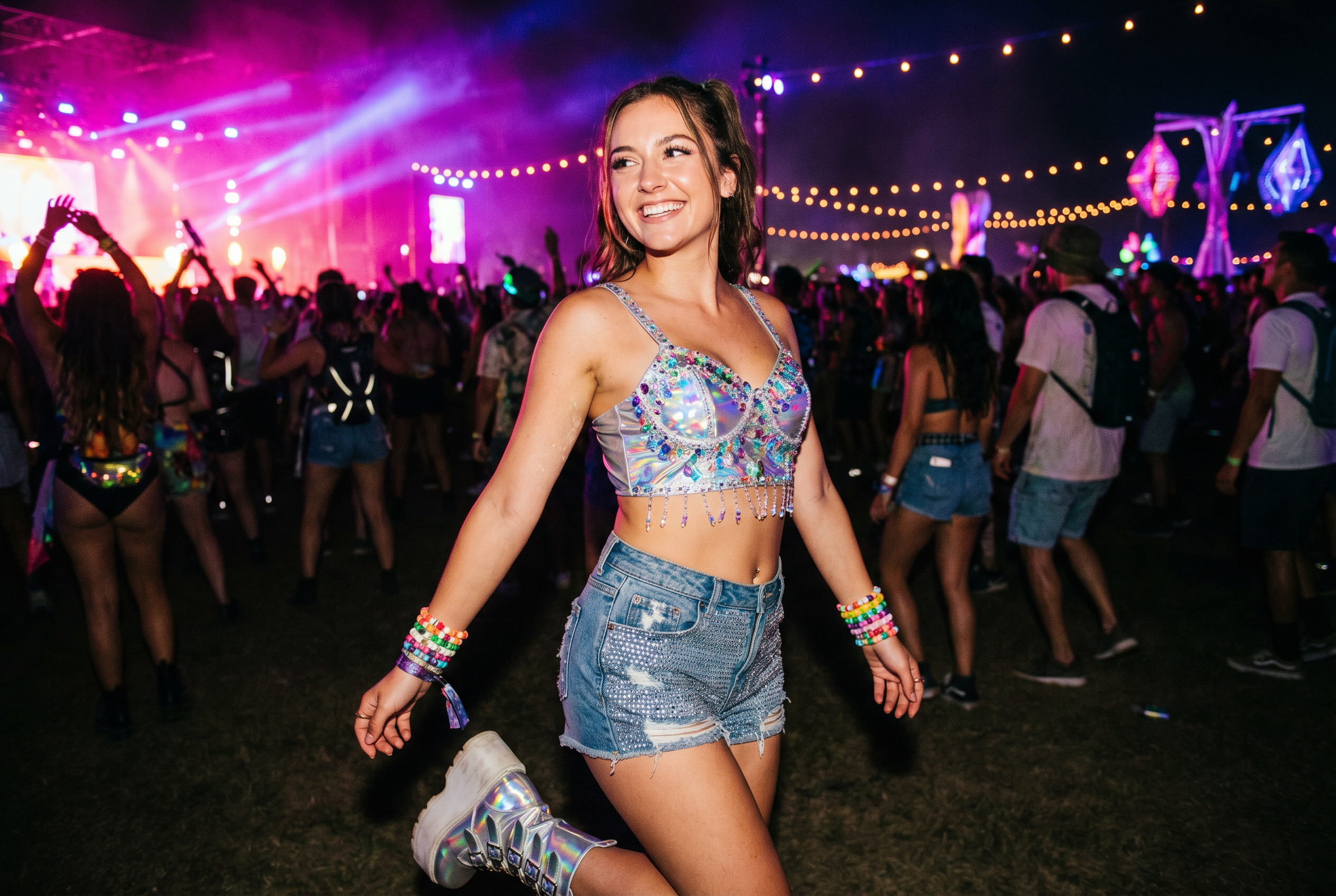
The best outfit at EDC was always handmade. Not because buying is wrong — but because the floor rewards intention, and nothing communicates intention like something you built yourself. In 2026, DIY rave fashion is having its biggest moment in a decade: the aesthetics are more defined, the materials are more accessible, and the cultural permission to go as far as you want has never been broader.
The internet hasn’t kept up. Most DIY rave guides still recommend flower crowns and basic fishnets from 2018. This guide doesn’t. It covers every current aesthetic, every skill level, and every budget — from a $15 thrift flip to a $150 custom build. By the end, you’ll have a complete plan for your next look.
What Makes a DIY Rave Outfit Actually Work in 2026
Before you buy a single piece of fabric, you need a mental model. A great DIY rave outfit isn’t just visually striking — it survives eight hours of dancing, reacts to blacklight, photographs well, and feels like you. Those four criteria are your filter for every decision.
The 2026 Rave Aesthetic Landscape: Which Visual Language Is Yours?
Five major aesthetic clusters are defining rave fashion right now. Each has a distinct DIY entry point:
Y3K Futurism — Chrome, holographic, and metallic finishes. The aesthetic is post-human and maximalist. DIY entry: chrome body paint + holographic spandex base layer.
Fantasycore — Crochet, fiber optics, mushroom prints, and forest-nymph silhouettes. Dominant at Electric Forest 2025. DIY entry: handmade crochet bralette + fairy lights threaded into a sheer cape.
Neo-Cyberpunk — Black bases, neon accents, hardware buckles, and reflective chrome. The Ultra Miami aesthetic. DIY entry: black base layer + hardware-store buckles + neon tape details.
PLUR Maximalism — UV-reactive layers, Kandi stacks, tie-dye, and color-saturated everything. The classic rave DIY aesthetic, now evolved with 3D Kandi and NFC beads. DIY entry: UV-spray denim + Kandi cuffs + glow accessories.
Techno Minimalism — All-black, structural, and restrained. The Berlin warehouse aesthetic. DIY entry: military surplus thrift flip + chest harness as the single statement piece.
The Four Non-Negotiables: Movement, Light, Durability, and You
Movement: You’re dancing for eight or more hours. Anything that restricts your range of motion, rides up, or needs constant adjustment will ruin your night. Test every DIY piece before the event — dance in it, crouch in it, raise your arms.
Light: Rave environments cycle between UV blacklight, colored stage wash, and near-total darkness. UV-reactive fabrics, reflective materials, and LED elements all behave differently under each. Build your look to perform in all three.
Durability: Sweat, crowd contact, and hours of movement will stress every seam, adhesive, and embellishment. Use fabric glue rated for stretch fabrics. Heat-set rhinestones rather than gluing them. Test your construction before the event.
You: The most important filter. A look that doesn’t feel like you will feel like a costume. The best DIY rave outfits are extensions of identity, not performances of a trend.
No-Sew DIY Rave Outfits: Start Here If You’ve Never Made Anything Before
No sewing machine required. The no-sew approach uses thrift finds, fabric glue, iron-on elements, and body accessories to build a complete look. It’s the highest-volume DIY method for a reason: it’s fast, cheap, and forgiving.
The Thrift Flip: Building Your Base Layer for Under $20
Goodwill, Depop, and ThredUp are your first stop. What to look for: mesh tops and dresses (any color — you’re going to cut and customize them), lycra or spandex pieces in any condition, fishnet tights in multiple sizes (worn as tops, skirts, or layering pieces), and any bodysuit in a solid color.
What to skip: anything with heavy structure (blazers, denim jackets) that won’t move with you, delicate fabrics that will shred under embellishment, and anything that fits poorly in the shoulders — that’s the hardest thing to fix without sewing.
The cut is your most powerful no-sew tool. A mesh dress becomes a layering piece. A t-shirt becomes a crop. Fishnet tights become a top when you cut off the waistband and step into the leg holes. Scissors and confidence are your primary tools.
Embellishments That Do the Heavy Lifting: Rhinestones, Iron-Ons, and Fabric Paint
Rhinestones: Use E6000 fabric adhesive for flat-back rhinestones on stretch fabric. Apply in small sections and let cure for 24 hours before wearing. For UV-reactive looks, source UV-reactive rhinestones from Etsy sellers — they’re widely available and photograph dramatically under blacklight.
Heat-transfer vinyl (HTV): Requires an iron or heat press. Works on cotton, polyester blends, and some spandex (test first). Available in holographic, chrome, neon, and UV-reactive finishes from craft stores and Amazon. A small piece of holographic HTV on a plain bralette transforms it completely.
UV-reactive fabric spray: Tulip and Jacquard both make UV-reactive fabric paint that works on most fabrics. Apply in patterns, gradients, or all-over coverage. Dries flexible and survives washing. One of the most cost-effective ways to make any thrift piece glow.
Puff paint: Underrated for rave use. Adds texture and dimension to flat fabric. Use it to create raised geometric patterns, write phrases, or outline shapes. Dries overnight and holds up well to movement.
No-Sew Assembly: Three Complete Looks You Can Build Tonight
Look 1 — UV Mesh Maximalist: UV-reactive mesh crop top (thrift or Amazon, ~$8) + black high-waist shorts + UV-reactive rhinestone detail across the collarbone (E6000 + rhinestones, ~$6) + Kandi stacks + platform boots. Total: ~$30–$45.
Look 2 — Chrome Minimalist: Black bodysuit (thrift or Amazon basics, ~$10) + holographic HTV geometric detail on the chest (iron-on, ~$5) + silver hardware belt (thrift, ~$4) + black fishnet tights + chunky boots. Total: ~$25–$40.
Look 3 — Fantasycore Fairy: White or cream mesh dress (thrift, $6) + UV-reactive fabric spray in pastel gradient ($8) + clip-in fairy lights threaded through the mesh ($10) + flower crown with EL wire woven in ($12) + white platform sneakers. Total: ~$40–$55.
Intermediate DIY Rave Outfits: Sewing, Sourcing, and Building Something Memorable
If you have basic sewing skills — or access to a machine — you can build pieces that no thrift store will ever have. The intermediate approach is about fabric sourcing, simple construction, and one signature piece that anchors your entire look.
Fabric First: UV-Reactive, Holographic, Mesh, and Stretch — Where to Source Each
Spandex World (spandexworld.com): The best online source for stretch fabrics in bulk. UV-reactive spandex, holographic lycra, and metallic stretch all available by the yard. Order swatches before committing.
Etsy: The best source for specialty rave fabrics — UV-reactive mesh, custom-printed spandex, and holographic organza from small sellers who understand what you’re building. Search “UV reactive fabric” or “holographic spandex yard.”
Fabric.com: Good for basics — stretch mesh, swimwear lining, and standard spandex. Less specialty than Spandex World but faster shipping and reliable quality.
Stretch percentage matters: For bodysuits and anything worn close to the body, you want at least 50% stretch in both directions. For skirts and capes, less stretch is fine. Check the product description before ordering.
Simple Patterns Worth Mastering: Triangle Top, Wrap Skirt, and the DIY Bodysuit
Triangle top: Two triangles of fabric, two ties, and a back strap. The simplest possible construction. Dozens of free patterns on Pinterest and YouTube. In holographic or UV-reactive fabric, it’s a complete statement piece.
Wrap skirt: A rectangle of fabric with two ties at the waist. No pattern required — measure your hip circumference, add 12 inches, cut to your desired length, hem the edges, and attach ties. Takes 30 minutes with a machine.
DIY bodysuit: More complex but worth learning. Free patterns from Evelyn Wood Designs and Patterns for Pirates are beginner-friendly. In UV-reactive spandex, a custom bodysuit is the single most impactful DIY piece you can build.
The DIY Harness: One of the Most Worn Rave Accessories, and It’s Easier to Make Than You Think
A body harness is one of the most versatile DIY rave accessories you can build — it layers over anything, fits any aesthetic, and communicates exactly the energy you want to bring to the floor.
Materials: 1-inch elastic or pleather strapping (3–4 yards), O-rings or D-rings in silver or black (8–12 pieces), a rivet setter or strong fabric glue, scissors. Total cost: $15–$25 from a leather supply store or Amazon.
Basic construction: Cut strapping into sections — two shoulder straps, one chest band, two waist bands. Connect at intersections with O-rings, looping the strap through the ring and securing with rivets or glue. Fit on your body and adjust before final securing.
Sizing note: Measure your chest and waist before cutting. Add 4 inches to each measurement for overlap at the ring connections. For plus-size builds, increase strap length proportionally and use larger O-rings (1.5-inch) for a cleaner look.
DIY Rave Outfits by Aesthetic: Build the Look That Matches Your Scene
This is the core of the guide. Each aesthetic has a specific DIY approach — materials, techniques, and the one piece that makes it read correctly.
Y3K Futurism: Metallic, Holographic, and Chrome-Finish DIY Looks
The Y3K aesthetic is built on the idea that the future is already here and it’s wearing chrome. Materials: holographic spandex for the base, chrome vinyl for accents, metallic bodysuit as the foundation.
DIY focal point: Chrome body paint (Mehron Metallic, ~$12) applied to the shoulders and collarbone over a holographic bodysuit creates a seamless chrome-to-fabric transition that photographs like a fashion editorial. Pair with silver platform boots and minimal accessories — the chrome does the work.
Accent technique: Cut geometric shapes from chrome vinyl (available at craft stores) and apply to an existing black bodysuit using fabric adhesive. Triangles, chevrons, and asymmetric panels all work. The contrast between matte black and reflective chrome is the visual engine of this aesthetic.
Fantasycore: Crochet, Fiber Optics, and the Electric Forest DIY
Electric Forest 2025 established Fantasycore as a fully realized aesthetic genre — and it’s the most technically rewarding DIY category because handmade materials are the point. A store-bought Fantasycore look misses the entire message.
Crochet bralette: Free patterns are widely available on Ravelry and YouTube. Use cotton or acrylic yarn in cream, sage, or dusty rose. The skill level is beginner-to-intermediate. A completed bralette takes 4–6 hours and costs under $10 in materials.
Fiber optic cape: Purchase pre-made fiber optic fabric from Amazon (~$25–$40 for a yard) and cut to your desired cape shape. Hem the edges with fabric glue. The fiber optic strands are integrated into the fabric and connect to a small battery pack at the hem. Wear over a crochet bralette and high-waist shorts for the complete Forest look.
Mushroom print: Etsy sellers offer custom mushroom-print spandex by the yard. Use it for a wrap skirt or wide-leg pants paired with the crochet top. The print signals Forest fluency immediately.
Neo-Cyberpunk: Black, Neon, Hardware, and the Ultra Miami Aesthetic
Ultra Miami rewards the edit. The Neo-Cyberpunk DIY approach is the fastest of all five aesthetics because most components are found items and hardware store picks — no sewing required.
Base layer: Any black bodysuit or black crop top + black high-waist shorts or leggings. The base should be completely matte — avoid anything with sheen at this stage.
Hardware: Visit a leather supply store or hardware store for buckles, D-rings, and speed clasps. Attach to existing garments using Chicago screws (no sewing) or strong fabric adhesive. A single hardware-accented belt transforms a plain black outfit into a cyberpunk statement.
Neon accent: One piece of neon — a single neon strap, a neon waistband, or neon tape applied to boots — is all this aesthetic needs. Restraint is the point. The neon should feel like a system error, not a decoration.
Reflective element: Chrome mini-skirt (thrift or Amazon, ~$20) worn over black leggings. Under stage lighting, it reads as liquid mercury. Under blacklight, it disappears into the dark — which is exactly right.
PLUR Maximalism: Kandi-Everything, UV Reactive Layers, and the Colorful Classic
PLUR Maximalism is the most community-coded of all rave aesthetics — and the most forgiving for DIY beginners because the look is built on accumulation rather than precision.
UV-reactive base: Start with a white or neon base layer and apply UV-reactive fabric spray in your chosen color palette. Tie-dye technique works well here — scrunch the fabric, apply spray in sections, let dry. The result is unique to you.
Kandi stacks: Make your own singles using pony beads and elastic cord. Standard singles are 30–35 beads on a 12-inch cord. For 3D Kandi Cubes, search YouTube for “3D Kandi cube tutorial” — the construction is geometric and satisfying. NFC-integrated Kandi (with embedded NFC chips from Amazon) turns your handmade pieces into digital business cards.
Layering: UV-reactive fishnet over the base layer, Kandi stacks on both wrists and upper arms, UV-reactive face gems, and a UV-reactive hair accessory. The look is built in layers — each one adds to the whole.
Techno Minimalism: The Berlin DIY Look That’s All About Restraint
Techno Minimalism is the hardest aesthetic to DIY because the quality of the edit matters more than the quantity of the pieces. One wrong element breaks the entire look.
Thrift strategy: Military surplus stores and workwear thrift sections are your primary sources. Cargo pants, structured black jackets, and industrial-cut trousers all work. Look for pieces with interesting hardware, unusual seaming, or structural details — not decoration.
The single statement piece: A chest harness (DIY using the instructions above, or sourced from a leather goods store) worn over a plain black long-sleeve top is the complete Techno Minimalist look. Nothing else is needed. Add black platform boots and you’re done.
What not to add: No color. No rhinestones. No prints. The discipline of this aesthetic is the point — every addition weakens it.
DIY Rave Accessories: The Details That Elevate Any Outfit
Accessories are the highest-leverage DIY opportunity at any budget. A basic outfit becomes a standout look with the right finishing touches.
Kandi: Making, Trading, and Stacking the Culture
Kandi is the most community-embedded DIY practice in rave culture. Making your own singles — single-strand bracelets traded in the PLUR handshake — is a rite of passage. The materials are cheap (pony beads and elastic cord, ~$8 for 200 singles’ worth of materials), the technique is simple, and the cultural weight is enormous.
2025–2026 evolution: 3D Kandi Cubes are the dominant structural innovation — geometric, multi-dimensional constructions worn as wrist sculptures. NFC Kandi (beads with embedded NFC chips that link to your social profile when tapped) turns the physical trade into a digital handshake. “Unhinged Kandi” — absurdist phrases replacing traditional PLUR messages — has become one of the most-shared categories of rave content online.
DIY LED and Glow Accessories: EL Wire, LED Strips, and App-Controlled Light Pieces
EL wire: Available from Amazon and SparkFun in multiple colors. Flexible, lightweight, and battery-powered. Sew or glue along seams, edges, or as standalone accessories (headbands, wrist wraps). Runs 8–12 hours on AA batteries.
LED strip integration: Flexible LED strips can be sewn into the hem of a skirt, the edge of a cape, or the brim of a hat. Use a small USB power bank as the power source — clip it to a waistband or tuck into a pocket. App-controlled RGB strips (Govee, Daybetter) let you change colors and patterns from your phone.
Fiber optic accessories: Pre-made fiber optic headbands and wrist cuffs are available on Amazon for $15–$25. They’re not DIY in the strictest sense, but they’re the easiest way to add a high-impact light element to any look.
DIY Rave Makeup and Body Paint: The Face as Part of the Outfit
Your face is part of your outfit. Treat it that way.
UV-reactive face paint: Mehron Paradise and Snazaroo both make UV-reactive face paint that’s skin-safe and easy to apply with a brush or sponge. Apply geometric shapes, constellation patterns, or abstract color fields. Under blacklight, the effect is dramatic. Under normal light, it reads as bold graphic makeup.
Body paint: For full-torso chrome effects (the “Chrome Skin” trend from Ultra Miami 2025), use Mehron Metallic powder mixed with a skin-safe mixing liquid. Apply with a large brush in overlapping strokes. Set with a light dusting of setting powder. Lasts 6–8 hours with minimal touch-up.
Rhinestone placement: The “Rhinestone Map” trend — facial gems placed along bone structure rather than masking it — is the current standard. Apply gems along the cheekbones, brow bone, and temples using cosmetic-grade adhesive (Duo eyelash glue works well). The result frames the face as topography rather than covering it.
Glitter safety: Use only cosmetic-grade fine glitter on skin and near eyes. Craft glitter has sharp edges that can scratch the cornea. Bio-glitter (plant-based, biodegradable) is the current community standard for eco-conscious ravers.
Hair for the Floor: Easy Rave Hair That Holds Through 12 Hours of Dancing
Space buns: The most durable rave hairstyle. Two high buns secured with bobby pins and hairspray. Wrap EL wire around each bun for the light-up version. Holds through 12 hours of dancing with minimal touch-up.
Faux locs with EL wire: Pre-made faux loc extensions can be threaded with EL wire before installation. The result is a full head of glowing locs that move with you. Installation takes 2–3 hours but lasts the entire festival.
UV-reactive clip-in extensions: Available from Etsy and Amazon. Clip in over your natural hair for instant UV-reactive color. No commitment, no damage, and the effect under blacklight is immediate.
DIY Rave Outfits for Every Body: Inclusive Sizing, Gender-Neutral Looks, and Building for Your Shape
The rave floor is for every body. This section covers the adjustments that make every technique above work regardless of your size, shape, or gender expression.
Plus-Size DIY Rave: Sizing Up Every Technique Without Compromising the Look
Fabric sourcing: Order extra yardage — at least 25% more than the pattern calls for. For stretch fabrics, the stretch percentage matters more at larger sizes: use fabrics with at least 60% stretch in both directions for bodysuits and close-fitting pieces.
Harness sizing: Use 1.5-inch strapping instead of 1-inch for a more proportional look. Increase strap length by 6–8 inches across all sections. Larger O-rings (1.5-inch or 2-inch) create cleaner connections and a bolder visual statement.
Thrift strategy: Plus-size thrift finds are inconsistent — size up aggressively and plan to cut. An XL men’s mesh shirt becomes a layering piece for any body. Oversized pieces are your canvas.
Gender-Neutral and Masc-Presenting DIY Rave Looks
The Techno Minimalist and Neo-Cyberpunk aesthetics are naturally gender-neutral — they’re built on silhouette and hardware rather than traditionally gendered garments. For masc-presenting looks:
Cargo pants as DIY canvas: Military surplus cargo pants with hardware accents (D-rings on the pockets, buckle details on the legs) are a complete lower-body look. Pair with a plain black tank or a chest harness as the upper-body statement.
Chest harness: The chest harness reads as a statement piece across all gender expressions. For masc-presenting looks, wear it over a plain black tank or directly on skin. The hardware communicates exactly the right energy for both Techno Minimalist and Neo-Cyberpunk aesthetics.
Full-coverage base layers: Black long-sleeve compression tops, black turtlenecks, and black mock-neck tanks all work as gender-neutral foundations. Layer accessories over them rather than revealing skin.
Budget Breakdown: What a Complete DIY Rave Outfit Actually Costs
| Tier | Budget | What You’re Building |
|---|---|---|
| Thrift + Embellish | Under $30 | Thrift base layer + fabric spray + rhinestones + Kandi |
| Mixed DIY | $30–$75 | Thrift base + one sewn or sourced statement piece + accessories |
| Custom Build | $75–$150 | Specialty fabric + sewn bodysuit or harness + LED accessories |
Where to Source Every Component: The DIY Rave Material Shopping Guide
Spandex World — UV-reactive and holographic stretch fabrics by the yard. Best prices for bulk orders.
Etsy — Custom UV fabric, harness hardware, NFC beads, UV-reactive rhinestones, and specialty prints. The best source for things that don’t exist in mainstream retail.
Amazon — Pony beads, elastic cord, EL wire, LED strips, UV-reactive fabric spray, iron-on vinyl, and basic bralettes/bodysuits. Fast shipping, reliable basics.
Goodwill / ThredUp / Depop — Base layers, thrift flips, and unexpected finds. Budget: $5–$20 per piece.
Local craft stores (Joann, Michaels) — Rhinestones, fabric paint, heat-transfer vinyl, fabric glue, and sewing notions. In-store means you can test before buying.
Leather supply stores — Harness hardware: O-rings, D-rings, buckles, Chicago screws, and strapping. Often cheaper than Amazon for hardware-specific items.
When DIY Isn’t Enough: How to Elevate Your Look With One Statement Piece
The best DIY outfits mix handmade with intentional purchases. A single high-quality piece — a UV bodysuit, a body harness, a pair of platform boots — anchors the entire look and makes every DIY element around it read as deliberate rather than assembled.
Think of it this way: your DIY pieces are the context. The statement piece is the subject. The harness you buy is the thing the eye goes to first; the Kandi you made is the thing people ask about second.
You don’t need to buy everything. You need to buy one thing well.
FAQ: DIY Rave Outfits — The Questions Everyone Searches
How do I make a rave outfit without sewing? Use the thrift flip approach: buy a base layer, cut it to shape, and embellish with fabric glue, iron-on vinyl, UV-reactive spray, and rhinestones. No sewing required for a complete, high-impact look.
What fabric is best for rave wear? UV-reactive spandex or holographic lycra for close-fitting pieces. Stretch mesh for layering. Both are available from Spandex World and Etsy. Look for at least 50% stretch in both directions.
How do I make UV-reactive rave clothes? Apply UV-reactive fabric spray (Tulip or Jacquard) to any light-colored fabric. Alternatively, source UV-reactive spandex from Spandex World and sew or glue your pieces. UV-reactive rhinestones add point-source glow.
What should I wear to my first rave? Start simple: a comfortable base layer (bodysuit or crop top + shorts), one statement piece (Kandi stacks or a UV accessory), and comfortable shoes you can dance in for hours. Build complexity once you know what the environment feels like.
How do I make Kandi for a rave? Thread pony beads onto 12-inch elastic cord in your chosen pattern. Tie a secure knot. A single takes 5–10 minutes. For 3D Kandi Cubes, search YouTube for step-by-step tutorials — the technique is geometric and satisfying once you understand the structure.
What’s the easiest DIY rave costume? The no-sew thrift flip: black bodysuit + UV-reactive rhinestone detail + Kandi stacks. Three components, under $40, and it reads as intentional at any event.
How do I make a DIY harness for a rave? Use 1-inch elastic or pleather strapping, O-rings, and fabric adhesive or rivets. Cut strapping to length, loop through O-rings at intersection points, and secure. Full instructions are in the Intermediate DIY section above.